
Smart Computing Frontier (SCF 2026)
Agentic AI as a Service (AAIaaS)

August 22 - 25, 2026, Kuala Lumpur, Malaysia
From Intelligent Capabilities to Smart Systems that Perceive, Reason, Collaborate, and Act
Smart Computing Frontier 2026 brings together ten co-located international conferences and a global community of researchers, industry practitioners, technology leaders, and innovators. Together, they explore how computing can move beyond isolated intelligence to deliver coordinated, trustworthy, and outcome-oriented services in the real world.
Explore SCF 2026:
• Explore the Conferences
• Submit a Paper
• Registration
• Become a Volunteer
From Intelligent Computing to Smart Computing
Intelligent Computing has transformed the capabilities of machines through advances in artificial intelligence, models, algorithms, data-driven learning, scalable computing, and automated reasoning.
Smart Computing asks a broader question:
How can intelligence understand context, coordinate decisions, take responsible action, and continuously create value?
Smart Computing does not replace Intelligent Computing; it builds on it. The emphasis expands from technical capability to complete, dependable outcomes:
· from model-centered computing to task-centered systems;
· from isolated intelligence to coordinated system-level intelligence;
· from passive responses to goal-directed action;
· from individual functions to end-to-end service loops; and
· from systems that can answer to systems that can help complete real-world missions.
At SCF, services provide the organizing fabric that connects computing infrastructure, data, trust, intelligence, interaction, and action. This service-oriented perspective makes advanced capabilities discoverable, composable, governable, and reusable across applications and domains.
The SCF Smart Computing Ecosystem
SCF 2026 organizes ten focused conferences into five complementary layers. Each conference maintains a distinct technical identity while contributing to a shared Smart Computing ecosystem.
1. Computing Foundation
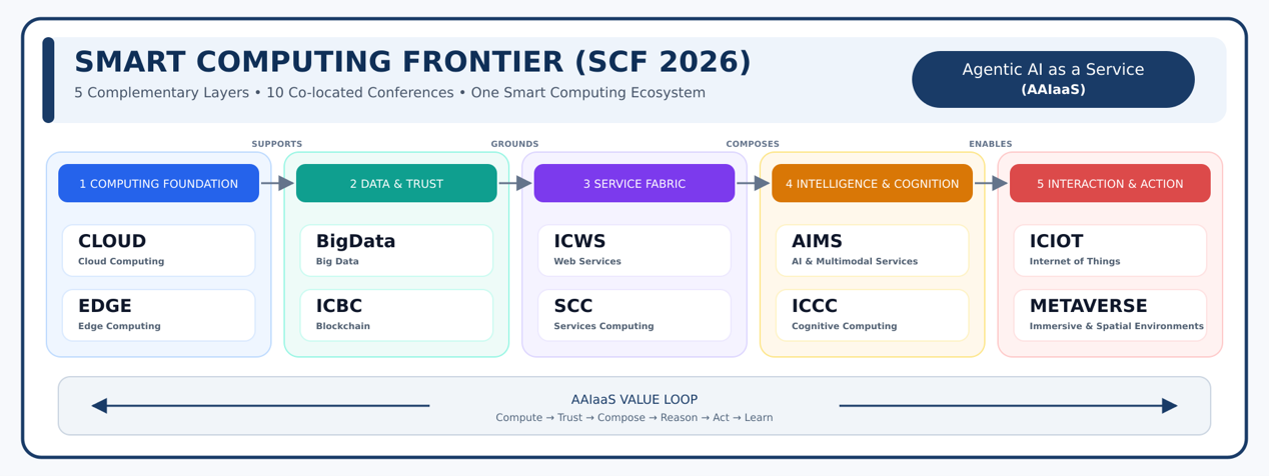
Where intelligent workloads run efficiently, elastically, and close to where value is created.
• CLOUD 2026 — cloud platforms, runtimes, resource management, elasticity, and intelligent cloud operations.
• EDGE 2026 — edge–cloud coordination, computation offloading, real-time processing, privacy, and edge intelligence.
2. Data and Trust
What smart systems know, how they learn from data, and how their interactions become verifiable.
• BigData 2026 — data architectures, engineering, large-scale analytics, quality, governance, and agent-ready data foundations.
• ICBC 2026 — blockchain systems, consensus, smart contracts, decentralized identity, and verifiable trust among autonomous participants.
3. Service Fabric
How distributed capabilities are exposed, discovered, composed, operated, and governed as services.
• ICWS 2026 — Web APIs, protocols, standards, service discovery, composition, semantics, and Agentic Web services.
• SCC 2026 — service modeling and engineering, lifecycle management, orchestration, quality, governance, and value creation.
4. Intelligence and Cognition
How systems perceive, learn, reason, remember, generate, and collaborate with people and other agents.
• AIMS 2026 — artificial intelligence and multimodal services, generative interaction, multimodal learning, and agentic multimodal systems.
• ICCC 2026 — cognitive architectures, memory, knowledge, reasoning, metacognition, and human–AI collaboration.
5. Interaction and Action
Where intelligence connects with devices, spaces, people, and persistent digital environments to create real-world value.
• ICIOT 2026 — connected devices, sensing, actuation, interoperability, and agentic Internet of Things systems.
• METAVERSE 2026 — immersive and spatial computing, digital humans, embodied agents, persistent environments, and virtual-world governance.
Together, these five layers form a continuous value loop:
Compute → Trust → Compose → Reason → Act → Learn
Cross-layer feedback, security, interoperability, governance, and human oversight are essential throughout this loop.
SCF 2026 Theme: Agentic AI as a Service
AI is evolving from a tool that is called to an agent that can pursue goals. Future systems will increasingly perceive conditions, plan tasks, use tools and services, collaborate with people and other agents, execute actions, observe results, and improve over time.
Agentic AI as a Service (AAIaaS) is SCF 2026’s unifying direction for this evolution. It examines how goal-directed AI capabilities can be delivered through service-oriented architectures so that they can be discovered, composed, operated, observed, governed, and reused across organizational and technical boundaries.
AAIaaS represents several important transitions:
· from models as endpoints to agents as service participants;
· from one-step inference to task planning and execution;
· from single-agent capability to multi-agent and human–agent collaboration;
· from opaque automation to observable and governable service processes; and
· from experimental demonstrations to reliable deployment in enterprises, cities, science, industry, and society.
SCF 2026 invites foundational research, enabling technologies, system architectures, engineering methods, applications, and experience reports that can make agentic services useful, trustworthy, interoperable, efficient, and accountable.
SCF as a Global Platform
SCF grew from the International Conference on Web Services community established in 2003. As service technologies expanded from Web-based systems to cloud, edge, big data, artificial intelligence, blockchain, cognitive computing, the Internet of Things, and immersive environments, SCF evolved into a federation of focused conferences under one shared platform.
This federation model gives participants two complementary benefits: a dedicated technical community for their primary contribution and a broader venue for discovering connections across the computing and service lifecycle.
SCF brings together researchers and practitioners who design foundational technologies, build and operate large-scale systems, establish architectures and standards, and apply computing to high-impact problems. By connecting these communities, SCF helps move ideas from research abstraction to engineering practice and from individual innovations to interoperable ecosystems.
SCF 2026 continues this mission in Kuala Lumpur by advancing Smart Computing and helping define the foundations of next-generation intelligent services.
Why SCF 2026
A Systems Perspective
Explore the complete path from infrastructure and data to services, intelligence, interaction, and real-world action.
Focused Technical Communities
Submit to the conference that best matches the paper’s primary contribution while benefiting from exchange with nine complementary communities.
Research and Industry Exchange
Connect foundational research with platforms, engineering practices, applications, deployment experience, and emerging business and societal needs.
Publication and Professional Visibility
Accepted and presented papers are planned for publication in Springer conference proceedings, subject to final editorial and publisher requirements. Inclusion in individual scholarly databases is determined by the policies and review processes of those indexing services.
Global Collaboration
Meet researchers, practitioners, students, standards contributors, entrepreneurs, and technology leaders from around the world.
Opportunities to Contribute
Participate as an author, speaker, reviewer, organizer, volunteer, sponsor, or community partner.
Join SCF 2026
SCF 2026 welcomes original research, application and industry contributions, emerging ideas, system demonstrations, case studies, and interdisciplinary perspectives aligned with one of its ten conferences.
Authors should select the conference whose central scope best matches the paper’s primary technical contribution. Cross-layer and interdisciplinary work is encouraged, but each submission should clearly identify its principal research community and contribution.
• Review the Submission Process
• Register for SCF 2026
• Join the Volunteer Community
• Explore Sponsorship Opportunities
August 22–25, 2026 · Kuala Lumpur, Malaysia
Join us in shaping the next frontier of Smart Computing and intelligent services.
SCF 2026 Organizing Committee
General Chairs
• Ali Arsanjani, Cloud Partner Engineering, Google
• Wu Chou, Vice President of Artificial Intelligence and Software, Essenlix Corporation
Coordinating Program Chair
• Liang-Jie Zhang, Shenzhen University
CFO and International Affairs Chair
• Min Luo, Services Society
Operation Committee
• Jing Zeng, China Gridcom Co., Ltd.
• Yishuang Ning, Tsinghua University
• Sheng He, Kingdee International Software Group Co., Ltd.
• Zhuolin Mei, Jiujiang University
Steering Committee
• Calton Pu, Georgia Institute of Technology, Co-Chair
• Liang-Jie Zhang, Shenzhen University, Co-Chair